
The Fit
T. Sargent Moore
I went out the other night, to a cafe where a large group of people I knew were all hanging out. But almost every time I thought of something to say, I heard the voice of my spiritual teacher in my mind: better not.
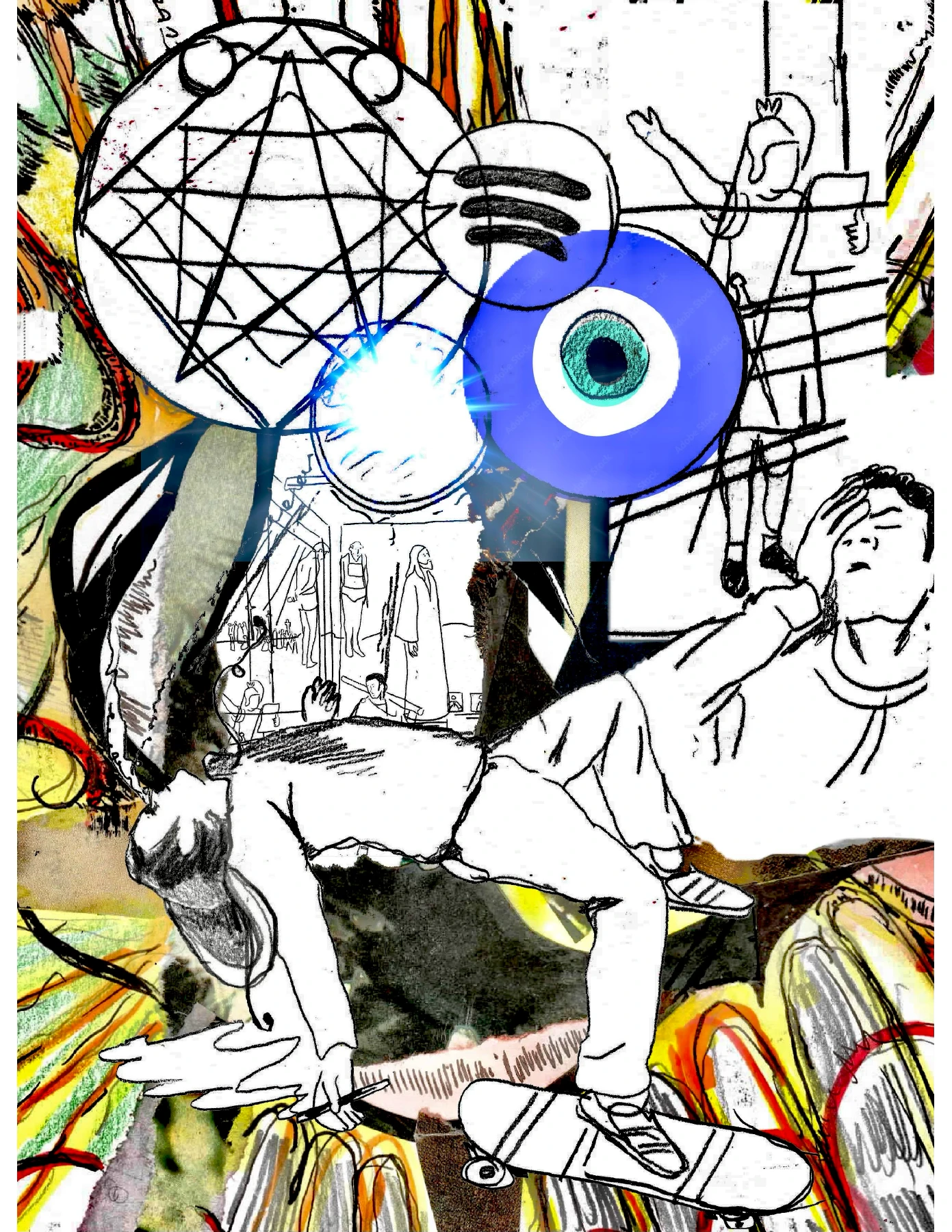
Better not, the voice said when I was thinking of striking up a conversation with the hooded wellness brand impresario. I wanted to ask her about a charity event that she had been scheduled to attend but had pulled out of at the last minute. She saw me looking at her and began to show off her glittering Richard Mille timepiece. It had a glowing eye that peered out from behind the whirring gears and ticking turbine.
“Wow, that’s crazy,” I said and quickly looked away.
A couple days later, I ran into an acquaintance of mine, a wannabe writer, at a different café. Her name was Ophelia. She seemed lonely, looking around all the time as if expecting someone to arrive, but no one did, so I sat down with her. We started talking and she almost immediately brought up being a writer.
“Have you ever published?” I asked.
“I’ve never been published but I did write, like, what I think it would sound like if I got a review in the LA Times, want to hear it?”
“Sure.”
“The Beverly Connection — that’s what it would be called, The Beverly Connection — critics are calling it the next great American PUNK-lit OVER-stimulated UNDER-rated POST-ironic AUTO-theoretical ‘raw, true and angry’ drug-addled paean to the FORGOTTEN DENIZENS of an UNSEEN AMERICA by an exciting new voice that’ll make you laugh out loud with its devilish wit. But underneath the surface, something serious is afoot. The author has something to say about society, something heedful.”
Ophelia looked at me expectantly.
“Sounds cool,” I managed. She rewarded me with a winning smile.
“It’s just hard, because I’m all about craft, economy of language, dramatic structure, you know, I read screenwriting books, even though it’s a novel, because those screenwriters have a rigorous formula, they treat writing like an engineering problem and I actually have a lot of respect for that, I don’t have a lot of patience for mystical thinking when it comes to the work of the artist, no. I’m thinking about making a substack,” she said, “but first I think I’m going to the hardware store to get a bunch of nails and chew on them until all my teeth fall out! Anyway, it’s hard because you talk to these so-called literary people and you bring up economy of language and they all just give you that autofiction stare. It’s just crazy, because during Covid I got all this weird online clout completely unintentionally because I guess people thought I was a good fashion designer, and because I was like losing my mind and posting about astrology, and even though I don’t do that anymore, I still get followed by accounts with names like ‘femcelnation’ and ‘perfectangelicism01dasha’, and I'm like. What the fuck are you doing with your life?”
Ophelia scowled in disgust, and then rocked back, rolling her eyes. Her phone chimed on the table but she didn’t look at it. She picked up her spoon and slowly swirled it in her coffee, and then looked around the cafe, her gaze stopping for a moment on each person around us, as if expecting one of them to suddenly answer the question she had asked.
She looked at me expectantly, but I didn’t say anything.
“I don’t even write much anymore,” Ophelia continued. “No time! Husky mix. Whole Foods. Pilates class. West Hollywood. Ryan sunglasses. Zoom calls. Mindfulness app. Pod Save America. Fucking my ex from 3 years ago when he’s in town. Green juices. That’s my life now. Haven’t seen anyone in days actually. My friend was supposed to meet me, but I know he’s just incapable of getting out of his house. The thing about your generation is you’re all being brainwashed by Spotify Discover Weekly and the Shoegaze Industrial Complex to be melancholic and FLAKY you know that, right? You’re unable to send a SIMPLE EMAIL, right?”
“You know, it’s funny,” I said, struggling to break in, “the only time I can send official-sounding emails is when I’m half asleep in the morning or in the middle of the night, and I check my email and I get something from a client or a job and deliriously respond. Then during the day I look back at it and I started the email with ‘Happy Monday’ and I’m like, what the fuck is wrong with me.”
“If you listen to Spotify Discover Weekly,” she said, “your brain stops developing at 17, basically. That’s why you’re like that. Arrested development. Like weed stunting your growth. Log TF off. Listen to Future. Just go on Youtube and look up Future. Future 2015.”
I looked at my phone. It was 4 o’clock.
I got up and said I had to go. As I walked out the door of the cafe, I swear I could feel her eyes following me through the walls, even from outside, and even when I was in my car, driving down Franklin, more than a quarter of a mile away.
***
A few weeks passed. I was feeling better. I was trying to forget about the things the spiritual teacher had told me, which was surprisingly difficult. Perhaps in an attempt to forget them, I had even begun to repeat some of the things Ophelia had said to people, playing the words’ fervor up for effect, without explicitly admitting it was a bit, even when pressed. It was ironic, though, that I was flattering her in this way, because during our conversation I had gone out of my way to appear completely nonchalant.
One rainy morning, I passed a poster for a special showing of the Hall of Crucifixion and Resurrection at Forest Lawn Museum. A large vinyl poster showed a long red curtain, partially opened on one side, a crowd of onlookers silhouetted before it. In between the hanging curtains the figure of Jesus stood beneath a vaulted sky, encircled by a small crowd milling about without paying him any attention.
I drove up a hill, passing long curving lines of gravestones. The museum was at the top. I went inside and asked the docent about the Hall of Crucifixion and Resurrection.
The docent told me the Hall typically conducted its audiovisual program once every hour on the hour during regular hours, which would have been at that very moment, but, as they were performing some routine yet involved maintenance, they needed another fifteen minutes to be prepared.
I walked outside while I waited. Dormant gray clouds hung high in the air, but the air beneath them was clear, and you could see for miles.
“Hey,” said the docent as I walked back into the gallery, “my boss told me he’d come out in a moment and talk to you.”
A few minutes later a man in a starched shirt and slacks emerged out of the staff area.
“Hey, thanks for waiting – as you know there is some maintenance being done but we’re going to have someone walk you through anyway, just so you can see the scale of it, even though you won’t be able to see everything. We’re going to show you some things visitors normally are not permitted to see, because technically the auditorium is closed to the public, so the maintenance actually gives us some freedom to behave as we choose.”
“That sounds amazing,” I said.
He told me to wait another fifteen minutes and disappeared. As I walked back outside, I heard voices from one side of me.
“See, I’m saying, like, that looks like somebody I would fuck with.”
There were three teenagers walking past the doorway, wearing baggy black jeans and hoodies. My mind struggled to believe that those were the words he’d said. I broke out in a grin. One of the other boys said something inaudible.
“Yeah, that’s the type of dude I think would be dope!” the first one repeated, turning to his friend. I looked at him.
“Well, you can fuck with me now,” I said, “what’s up?”
“Nothing bro, just cooling with the homies at the museum!” He had on a black snapback with a patch of Cartman from South Park wearing the pimp suit and devilish leer of Gangster Spongebob. I examined his face. His eyes were wide, darkened by the dilation of his pupils. They seemed to radiate pure energy, but also to completely absorb the energy entering them.
“Yeah?” I said. “You saw the art?”
“Yeah, it was hella crazy, I’m rolling right now so it was hella dope. I just gave my boy some shrooms too,” pointing to the boy with a chunky jaw and buzzcut.
The one in the hat introduced himself as Chris. “Are you from LA, bro?”
“Yeah, you?”
“We’re from Rancho.”
“Cucamonga?”
“Yeah fool, we’re all from Rancho.”
“Is there a lot to do out there?” I asked idiotically.
“Nah bro, there’s nothing to do,” he said. “I just went to Atlanta though.”
“Why?”
“I went with my sister!” he said, smiling widely, “and I just went to Utah with my boy too. You want to hit the penjamin, bro?”
“Sure, should I hit a blinker?”
“Yeah, fool!” He passed me the dab pen.
“Blinker, blinker!” shouted the other boys. It was the first time they’d spoken. Their voices echoed over the hills of the cemetery.
“Anyway, peace bro, nice to meet you, you’re sick,” said Chris.
“Wait, did you see the Crucifixion and Resurrection?”
They had no idea what it was. I told them I didn’t either, but I was going to be given a special tour, and it sounded cool. It was easy to convince them to join me.
We walked into the gallery to find the docent. Soon after, a bespectacled woman in a yellow raincoat emerged.
“Thanks so much for waiting. Just follow me and we can start with our tour.”
She led us out of the gallery. When she opened the door she had to brace herself against it, as a strong rain and howling wind had begun to pound down. She held the door open and then led us again outside, this time up a long staircase.
“Wow, it’s really horrible out here, sorry about that!” she shouted, struggling to be heard over the rain.
It fell in fat droplets. A strong wind battered them against the leaves of the trees, which writhed and whistled in arousal. The boys shivered and pulled their hoods up as we mounted the slick stone steps, grabbing onto the railings for support. I looked down at the long curving lines of headstones. They met at seemingly random angles on the ridges of the hillside.
At the top of the stairs was a building with a cathedral’s façade attached to a large, white bulb-shaped building that took up most of the summit of the hill.
“This way!” shouted the guide over the gale, motioning toward the façade. She grabbed a large metal handle and pulled open the heavy church door. Our shivering and the rustling of our jackets echoed throughout the reconstructed Gothic anteroom.
“This building was constructed to house the Crucifixion in 1934,” she said, leading us through another set of doors into a large auditorium.
“The Crucifixion is the largest religious painting in the United States, and the largest painting of any genre west of the Mississippi. It was painted by Jan Slivak and a team of trained underlings in Poland in the 19th century, then sent to America for the 1904 St. Louis World’s Fair. After it was exhibited, however, it was too expensive for Slivak to have it transported back to Poland, so it ended up being left wrapped around a telephone pole in a theater warehouse in Chicago for 30 years before we purchased it.”
Across the auditorium there was a stage that was mostly covered by curtains. The curtains were parted in the middle of the stages to reveal the two enormous paintings, one partially covering the other. There was a low droning and banging coming from the left side of the room.
“The paintings are mounted on giant tracks that bring them back and forth from their compartments backstage, in the studio space to the left of the auditorium, where they are currently performing the maintenance,” said the guide.
What was visible of the painting on the right showed a hill sloping down to the battlements of a walled Roman town. Crowds of horses and people climbed the hill. The left one was less wide but equally tall, and partially covered the right one, though only half of it was uncovered by the curtains. It showed a huge cloud above the same battlements, suffused with a heavenly blue-golden light. On the cloud were thousands of people, thousands stretching back as far as the eye could see, crowds dotted with churches, clergy, missionaries, crusaders, and common people too, warriors and farmers and craftsmen, women and children.
“The largest painting in the United States is at Gettysburg, but that painting is in the round, like this replica of the Crucifixion we have through this door here.”
The guide led us into a small chamber that contained a panoramic replica of the Crucifixion.
“Now, because this is a special tour where maintenance is being done, and the normal audiovisual program is impossible, and so everything is permitted, we’re going to take you up onto the stage,” she said, and gestured toward a door that read “RESTRICTED”.
She led us through the doorway out from the other side of the chamber housing the panoramic replica and brought us onto the stage. The floor was covered in thick bundles of cables connected to large stage lights, whose powerful beams illuminated the paintings from below.
As we followed her, I noticed Chris sneaking ghost hits from his dab pen, pulling his hoodie over his mouth to hide the smoke. His friend surreptitiously extended his hand toward him, motioning somewhat frantically with his hand by his hip, and after getting Chris’s attention, slipped the pen into his sleeve.
We stood in front of the paintings. I had to crane my neck to see the crowd of people on the cloud. There were legions stretching back into the far distance. The recognizable faces at the front became ghostly abstractions of human figuration the higher you looked, wispy clouds of people drawing into further and further reaches, layers of receding figures stacked on each other like ribbons of caramel, nougat, and chocolate in a tub of ice cream, or like scoops of ice cream themselves, stacked on top of a cone. I almost had to bend over backwards to see above them, to the steeples of great cathedrals piercing above even heaven itself. I was craning my neck so far back that I could see Chris behind me, his back turned away from me. The voice of the guide droned as she named the various cathedrals that were depicted in the painting. Chris suddenly shrieked in pain.
“My eyes!” he shouted. I turned around, almost falling over in the process due to the extension of my neck. He started coughing spasmodically, nearly invisible clouds of vapor escaping from his mouth. Chris covered his eyes with his hands in pain, shaking back and forth with the coughs that racked his body, hitting himself in the face over and over. One of his friends grabbed him and tried to help him stop coughing.
He had been staring into one of the stage lights. The dilation of his pupils had increased their vulnerability to the powerful lights, and the THC had slowed his reaction time and increased his tolerance for pain, so that he could reach a breaking point without even flinching, possibly permanently damaging his cornea. Another possible cause was the size of the paintings and our proximity to them. The brightness of the stage lights repulsed your gaze so that the only thing you could safely look at was the paintings, contributing to the illusion of their totality. Even the content of the paintings played a role: the inevitability of the Crucifixion, the mundanity of the provincial Roman scene that was nevertheless utterly determined to be exactly that way, down to every detail, may have lent itself to a sense of fate, as if Chris were never going to have made any choice that was any different from exactly the one that he made, which was to fix his gaze on the blinding light for several long seconds. Even such immaterial effects as the history of the room itself, where thousands of people had come over decades to confront the the crowd of the saved in the Resurrection, a history of mutual recognition that resulted in a sort of magnetism between eyes and the lights which they meet, even such an effect as this cannot be discounted if one wishes to understand why he did not remove his eyes from the light.