
Chaos Infinitum with Tom O’Neill
Tom O’Neill in conversation with The Big One
Venice, California, 1999. Journalist Tom O Neill receives a call: a routine magazine assignment for Premiere; a piece about the Manson murders. But as O’Neill begins digging around Los Angeles looking for new information on a case long considered closed, his initial task unfolds into a 20-year odyssey, a fractal of false leads and concealed truths about Manson and all the supporting players, a narrative no one likes involving bureaucratic coverups and a CIA-contracted psychiatrist by the name of Jolly West, stationed in the Haight, around the corner from the clinic where Manson and his family members received free care. After many twists and turns and a laundry list of death threats, O’Neill’s research finally results in a book of groundbreaking reporting that’s spent 36 weeks on the New York Times bestseller list to date, and a case that remains unsolved.
Chaos: Charles Manson, the CIA, and the Secret History of the Sixties hits the shelves in 2019, entering into a modern media landscape rife with bedroom conspiracy theorists, clickbait headlines, and sensationalist news conglomerates- in short, a populous craving a crazy story, but with little deference towards the kind of diligent reporting O’Neill devoted two decades to. Fortunately, the tides of zealous masses carry the story out to the corners of American culture where people still listen for a ring of reality.
26 years after his original magazine assignment, O’ Neill joins us via video call from his home office, surrounded by a quarter century’s worth of binders brimming with information on the case. We discuss the seemingly never-ending chase towards the truth, and all the strange sidequests it invites.
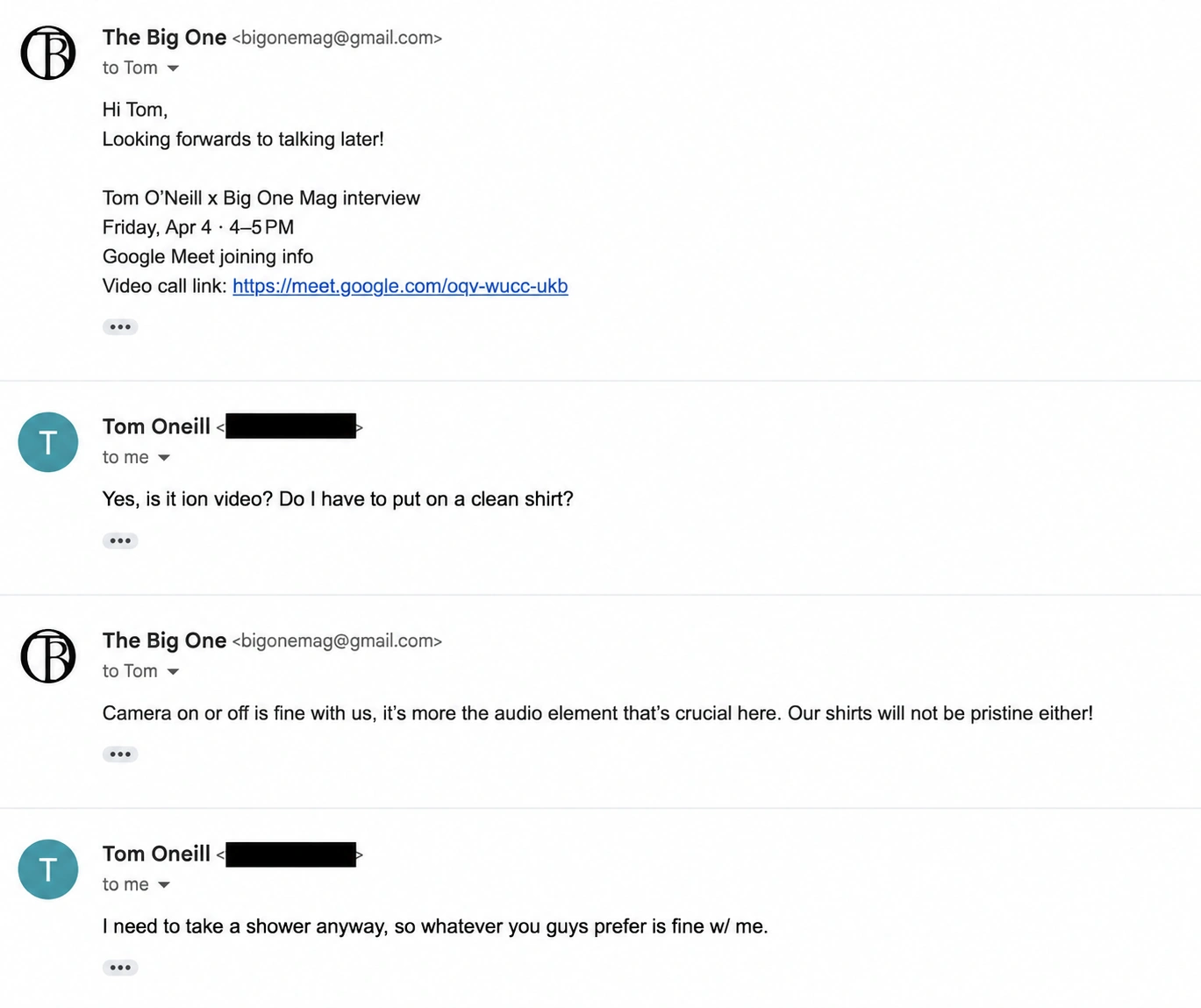
THE BIG ONE: Well, nice shirt. Yeah, clean shirt. We were thinking, we're like, honestly, we need to shower also. We're also brutally unshowered.
TOM O’NEILL: I came from the gym, I got my workout in early and I took a shower there. So I feel relatively clean.
TBO: I have to say, you kind of have a dream set up, just like, binders and binders full of hard, solid evidence. It’s a comforting view.
O’NEILL: Yeah, you really can't see but it goes up and down and all over the place. But it's inhibiting me because I want to move, but the idea of packing all this stuff up just paralyzes me.
TBO: Moving is horrible. Just like having to touch every single one of your possessions is a horrible feeling. You're like, this is all the trash I have.
O’NEILL: As an adult, I never willfully move. I've only moved when I've been evicted or my house got bulldozed. I'll do anything to avoid it. Even staying at a place I'm not happy at. This place- it's a shitty location. There's nothing. I'm in Mid City. But I'm in the middle of nowhere in Mid City. I can't walk any place. All my friends are either in Venice or Hollywood. I got a two bedroom apartment for $1,400, which is pretty amazing. Lots of light and air, it's quiet. I'm at the end of a dead end. There’s parking, but there's nothing to do here and it's kind of like rent prison because when you're paying so little… I started looking in Venice and then the fires happened and everything went crazy. But everything I saw comparable to this was twice as much.
Depending on if some good stuff happens, I might start looking again, or I might actually go back to New York. I can't decide.
TBO: We wanted to kick off by asking, any new leads today?
O’NEILL: It's really weird you ask. Right when I was leaving for the gym I got this amazing email. I thought, if I start trying to process this email now and take it apart and think about it and how important it looks like it could be, I'm not going to make it to the gym and be back in time to do [this interview]. It's a woman I've been communicating with for six or seven years, she teaches legal justice and violence. She's in the University of California system, and I've lectured to her class once or twice. She gets inside information. I shouldn't say too much cuz number one, I'm not sure if she's correct. I don't think I can save it for the next book. I might try to do something publicly about it. But it's a really good lead about [REDACTED]
I'm not like this, you know, I'm not deliberately being coy. I get stuff all the time and three quarters of it turns out to be just a waste of time. But stuff that this woman's given me before has been really solid and she knows she knows this world better than I do and like how things work in the prison system and the parole system. So I was pretty excited about that one. Tomorrow morning I'll look at it. I'm leaving the country a week from Monday for a month, so I'm trying to do a ton of shit before I go. I wanted to do three different posts on Instagram and my social media. About information I've never shared. It’s important.
TBO: We've been looking at your Instagram a lot because now you're posting a lot of your tapes and files, things you can finally just release directly to the public. Suddenly the interface is so immediate. We were thinking about how you started this story in 1999, and the 20 years that you were working on this story are also the 20 years when modes of research have changed more dramatically than probably any other time in history.
O’NEILL: Yeah, yeah, really. It was such a crazy evolution. In the beginning I was just barely using the internet for research, in 1999. I mean, I moved out here two years before, from New York, and I remember when I moved out to LA one of my friends here, a journalist, started telling me how valuable [the internet] was. But then there was so much less than what's available now. I still had to go to the library and go through microfiche and look at old clips and...
TBO: Microfiche?
O’NEILL: See, you don't even know it, it's horrible. It's like a film strip. And you run it though this massive machine. Every newspaper that the libraries had, they make these films of each page of the paper on a film strip. And you have to reel it through and it's always hard to kind of get on the right page and it breaks and it's negative. So the text is like white and everything else is black. It was just so unwieldy. And now you can get most everything online because they're all digitized.
TBO: Did you start tracking people down on social media at all, when that developed?
O’NEILL: Before social media, I had hired a detective, a retired Sheriff who had a private detective's agency. He was finding people for me. And then he got me to be on a website he used that was called Merlin- I don't know if it exists anymore. You had to have a PI license. And I didn't, and I think he got so tired of all the work I was giving him because it was tedious stuff and he was really good at what he did, and I guess he didn't have anyone working for him, and I think he gave me a low rate out of pity. He finally just said, look, if I tell them you're apprenticing for me, they'll give you access to the site. It was pretty expensive. Like I had to pay per search. But once I got that, then I would use that in combination with Facebook. And then I learned how to combine all the different platforms. Now people release a lot of personal information on Facebook, even more back then. A lot of the people who I'm looking for aren't on any kind of social media, but the families are, their friends are, and I can find them through that. I mean, I became a pretty good stalker. But it was all kind of learning while I did it.
TBO: Have you ever used blogs or things like reddit for leads, and are there more false leads now that you're using the internet?
O’NEILL: Well, yeah, like five years into it I started realizing how really dangerous the internet is because people are putting stuff up there that's not sourced. There's so much wasteful shit up there, and tons of people are writing me and saying that they read this online, is it true, or can I find that out, and there is no sourcing there, you know? Reddit... I never even used it until my book came out. My book came out in 2019. And some of my friends were saying, oh, you have to go on the Reddit page to see what they're saying about the book. And then Reddit asked me to do an Ask me something. Ask me Anything. And I wasn't going to do it because I thought it was just for QAnon people. But my publisher said no, it's legit. But they gave me the wrong time and day. And I've been told there'll be thousands of people that want to ask me stuff. I realized the night before that it was the wrong day by like a digit or something. And there was no one to contact. So when we finally went on, I had put stuff on my social media saying Reddit says it's supposed to be tomorrow at such and such, but it's actually today and if you want to ask questions… I think there were like 25 people on it. I'm sitting at home for the allocated time and nobody's asking me anything. So, um, I don't know if that's still up. I don't really go on there so much because it's just people saying nonsense on there. Not necessarily negative, although there's a lot of that, but just people trying to show the other people how much more knowledgeable they are about the case.
TBO: Your book came out summer 2019. Then COVID happens the next year… suddenly you have this proliferation of internet sleuths. Were there people like coming to you, turning to the book because they were investigating government conspiracies and such online?
O’NEILL: That happens to this day. People come to me looking for information that's so unrelated to what I've done, but just because it's a conspiracy book. Or they're looking into some kind of conspiracy, they think that I know that stuff. I mean I guess COVID was probably when it accelerated, but also that's when I went on Rogan. So that changed the whole trajectory, you know, the book came out June of 2019 and then I think I went on Rogan in March or April of 2020, right when the lockdown started.
TBO: You say it's a conspiracy book, but I feel like you're very much not a conspiracy theorist.
O’NEILL: I say conspiracy book, not in a negative way. So much of the stuff I have is proven, but the most important stuff is circumstantial. And involves different agencies working with each other in a secret way. So I use the word conspiracy kind of liberally. And I know that most people want to label me as that. But yeah, I mean, I take pains not to put anything out there that I haven't proven.
TBO: Yeah, it's very much just a collection of research and as a reporter you've left it where other people can pick it up and continue down the fractal. When we were speaking after your talk at Earth Gallery, I asked you a little bit about how you decide when to stop or when to move forward. When to put out that collection of research when you could just keep on going down the fractal further, because you always think the truth is around the corner. But I wanted to hear your answer again, because I don't remember what you said about it.
O’NEILL: Well the first time, with the first book, my agent was telling me for 10 years, you have to stop, you've got enough. And I said, Hey, this is my reputation out there. I don't have enough. I need more. And then finally, I got so broke, you know, and I had the publisher, one of the most prestigious publishers in the world, Penguin Press, first cancel the deal, which was heartbreaking. And then like six months later they filed a lawsuit against me for the return of the advance. Which was devastating.
TBO: Is it just because you took too long?
O’NEILL: That's what I don't know. What I was told at the time was that, I mean I say only, but it was really only six years. I signed a deal with them in 2005 or the end of 2005. And in 2011 they hadn't really given me a deadline, because they knew I needed a few more years of searching, but then they were panging me and, you know, when you get a book deal, you get an advance that's divided into three or four parts. You get the first part when you sign. And then with my book I told them I needed at least two years to continue reporting and they agreed to that and they said, yeah, there's so much great stuff that you're pretty close to getting. So after two years, if I reached a certain plateau, they were going to give me part of my second advance. Which they did. And then at that point, I think they gave me a deadline which I shouldn't have taken. 2012. So they canceled it. I was told it was the financial people, not the editorial people, and what I didn't know and I found out about a year or two later was Penguin was merging with Random House. And right before they sued me they had sued six, no, nine other authors, all of them much more well-known than me. Most of them had a couple books, New Yorker writers. All for the same reason, because they hadn't delivered their book. It was a huge story because publishers usually don't sue for returns of advances. It's kind of like Vegas, you know, they're gambling. And that's why they don't give you the whole of that, they’re hoping you're going to finish it. And it was so unfair to me because... You know, my book was harder and more complicated than any of those people's. When that happened, it was on the front page of the New York Times. It was such a big story. All those people had to pay back, but none of them had nearly as much as me. I can tell you, my advance was one and a quarter million dollars, which was unheard of for somebody who'd never written a book. There are advances for like a quarter million dollars, a half a million dollars.
When they sued me, it took me two years to resolve that lawsuit. I got a pro-bono lawyer. And we fought it and the resolution was that they gave up their lawsuits. I had to pay them back, you know, immediately, I had no money. I only had debt. So I would have had to declare bankruptcy. I wouldn't do that. My father was a tax attorney and he's like, don't do it. It's a disgrace, fight them. I said, I don't know how to win. And he said, well, you're just going to have to pay them back when you resell it. And I said to my dad, I said, my agent says we might never be able to resell it because now it has a black mark against it. But we fought them, and what I won was the only way I had to pay them back was if I re-sold it. So when I resold it to little Brown in 2017, almost the entire advance, about two-thirds of it, was taken up by me having to give it back to Penguin Press.
TBO: We wanted to ask you about the JFK files, the recent release. We saw your Instagram post where someone sent you excerpts from it. Have you looked at it yourself?
O’NEILL: I actually jumped the gun on that, I was worried that I posted it too quickly. That was a person that used chat- what's it called? - Chat GPT, to go through the entire collection and just compile anything that was said about Jack Ruby's psychiatric treatment. Dr.[Jolly] West is not named, but he’s referenced, it can only be him because the dates and times all coincide. So I got information that I hadn't had access to before that was in those files. I mean, I knew that Ruby’s behavior went haywire after West visited, but I had never heard what his own jailer said, which is in the files. And I think one of his lawyers says that ever since that doctor visited, Jackie's not been the same. So I wrote to the guy and I thought he had found all that out. He goes, no no, that's Chat GPT.
They released like 300 or 400 pages last night. They still haven't released everything. And there's also 2,000 pages the FBI found that still haven't been released. I don't want to get political but I don't like Trump at all, and I don't think any of this is sincere. I think he's just using it as a political maneuver, but it's not being done properly, the release. I mean, at least they're releasing stuff, but so much is redacted. They're withholding so much. He's not taking it seriously. I'm not that optimistic. I think that anything really damning they're never going to release, it was probably destroyed that year or something. But you know, if there's enough pieces of the puzzle put together, who knows what we'll see.
TBO: What has been the evolution of the CIA and FBI? How have you noticed those institutions change from the 1960s to now?
O’NEILL: You know, I really don't pay that much attention to what they’re up to now.
TBO: You're back in the Dulles Brothers era.
O’NEILL: Yeah, exactly. I mean, from what I've heard, though, because of DOGE and everything they're completely understaffed. I never got anything from them before this anyway, they never really said anything. But now supposedly The FOIA wait time has gone from a year to like a hundred years or something ridiculous. But as far as what they're doing internally or operationally, I have no idea.
TBO: You posted Peter Thiel's interview with Rogan on Instagram,
where [Theil] says,”I don't think these kinds of operations happen anymore,” and Rogan says, “Why not?” And [Theil] kind of pauses, and you say in your caption “Note the pause”. We were wondering what you know or what you're insinuating in the pause.
O’NEILL: Well, it's a problem because, he's an acquaintance of mine, kind of, but his pauses are always kind of telling and I've seen him pause about stuff before that he doesn't want to talk about. So I was just having a little fun with that. The reason I put that in was I have tons of haters out there. Do you know who Bret Easton Ellis is?
TBO: Of course!
O’NEILL: Peter really liked my book, and long story short in 2020, I think in the late spring of 2020. I was invited up to his house for a dinner party. Evidently he has a dinner party like one night a week where he invites someone who's interesting to him, and then he invites this very intimate group of almost all men. I mean, I've been to these dinner parties twice, and they’re all men, there's no women.
TBO: Yeah, that's what we’ve heard.
O’NEILL: Yeah,and there's never more than like a dozen people. And the first one, Bret Easton Ellis was there. And, you know, we have mutual acquaintances and stuff like that. He was great, he sat next to me and he said to me that he had been working on a mini-series about Manson for Fox for five or six years. And he said, “When your book came out I wasn't even going to read it until too many people told me I should, because I thought I knew more about anybody in the world except Vince Bugliosi about that case. And then I read your book and realized there was so much I didn't know.” So Bret does a podcast and evidently on that podcast he broke the cardinal rule, the understanding is that what happens at those dinner parties, you don’t talk about them. But he was talking about meeting me at the dinner party and some of the stuff we’d talked about. So all these people came after me saying “you're a CIA agent, you're embedded with blah blah blah.” So when I decided to do that post, Peter had said this to me in the last year what he’s saying in the first video, that he thought that MKULTRA was much more extensive, and there's much more horrible stuff that went on in the original 25 years than what we'd ever know about. And the second post I made was when Rogan asked him if it was still going on and there’s that long weird pause… So I think, I don't know, understand how secrecy works. I know he has all kinds of national security contracts and I mean Palantir, the surveillance company, that's enormous and supposedly they found Bin Laden, they have contracts with the CIA. So I think Rogan kind of put him on the spot maybe and he had to answer to the best of his ability. Yeah... I was a little worried about him seeing my posts, but he has a sense of humor.
TBO: Speaking of great writers like Bret Easton Ellis who are fascinated with Manson, we’re fans of Joan Didion and were curious to know about her connection to Linda Kasabian, if you know anything about how she got started on writing the Kasabian book and how it got buried?
O’NEILL: I think I might have had her letter tacked up here (looks around office) but I might have put it away… How did that happen. I guess Joan probably to Linda Kasabian's lawyer Gary Fleishman and said she wanted to kind of embed herself into the defence for Linda [Kasabian]and write about it. She started helping her prior to the trial, helped her pick the outfit to wear when she testified. Linda was in jail until her testimony, but as soon as she was free she completely blew Joan Didion off. In one of her books she wrote an essay about the beginning of her relationship with [Linda]. And Gary Fleishman said Linda just wanted more money from Joan, and I think Linda was a complete con-artist,and even Gary didn’t believe half of what she testified. So I reached out to Joan Didion in my early days of reporting hoping she’d have something, because she’s such a meticulous note-keeper. And she told me she got rid of everything. And, I didn’t tell her this, but we had a mutual friend who was her daughter Quintana’s best friend. I met her in New York, and you know, with my friends it was “Party hard with Quintana in SOHO”
TBO: Wow.
O’NEILL: It would be interesting to see if she was telling the truth. She could have forgotten, or maybe she didn’t even know, but I'm sure she had files and files at one point, because she was following Kasabian around and visiting her almost on a daily basis and I know she would have taken tons of notes and I wanted to find out – what’s her famous quote? “Stories…”
TBO: We tell ourselves stories in order to live.
O’NEILL: Yeah, and that was literal for Linda Kasabian, she told stories in order to live and not get executed. People always ask me who my real dream interviews were. The people who I thought had the most secrets, and she's in the top three. I spent a horrible rainy cold weekend in Spokane, Washington, where she lived – or it was Tacoma – trying to get access to her. I was able to get her daughter's address, I'd written to her, I'd called her. Her daughter had just gotten out of prison and was a hardcore gang member drug dealer whose street name was Lady Dangerous. And that was the point-person for me to get to Linda. And I would go to Lady Dangerous' house and just politely say, “Please, will your mom reconsider? I wouldn't knock at your door if I knew where she was.” And she'd say, “I'd never tell you where she was, get off my property,” and she had these really fearsome-looking men behind her in the house. It's scary. Linda died a couple of years ago, so she took her secrets to the grave.
TBO: Have you pursued Leslie Van Houten since she got out of prison?
O’NEILL: Um...I'll just have to be so careful about that.
TBO: Okay, okay.
O’NEILL: No, but I'll answer to the best of my ability. I asked her questions to her attorney who became a good friend of mine, her attorney of the last. Like 15 years prior to her release, but really without him, she never would have been released. He worked his ass off for no money, night and day. And he offered me jailhouse interviews. I turned them down. Off the record, this part?
[REDACTED]
[REDACTED]
[REDACTED]
TBO: That's shocking. Okay, well, that's awesome. Thank you for sharing that, now back on the record. You describe the hippie syndrome and culture so many times in the book. What were the central tenets of what made a hippie a hippie, and is there a modern-day equivalent in your opinion? Who are the hippies today?
O’NEILL: The irony is Manson despised hippies. And he called himself a slippy. And he said, “we're slippies, not hippies. We're slippy because we slip in and out and people don't see us.” Who would be the hippies today? You're asking an old guy who's completely out of touch with youth culture. With all this phones and Tiktok and stuff... To be a hippie,is just about freedom and NOT materialism, and it feels like - and I’m not casting aspersions - is there a group in the younger generation that doesn't care about materials, rules, wealth, and convention?
TBO: We're living in such an atomized culture, there aren’t as many clear outcasts, because everyone is so siloed and you're able to find your people through the internet and align with them. We’re asking you because we don’t know the answer. Maybe it’s a dead identity.
O’NEILL: I see groups of homeless kids down in Venice who really seem like they’re taking care of each other. Most of them seem like they might have serious drug or mental health issues, but they do seem to wander around communally. I mean superficially I’m like man, they take really good care of those dogs. Maybe it’s them, I’m not sure, I don;t want to romanticize it. It was such a unique time when all these cultural things happened at the same time. You know, LSD, Rock & Roll music, and people just abandoning conventions. We don’t have to get married, or have a nine to five job. We can have children and share the responsibility of raising them with the people who we love who aren't necessarily our partners. That all kind of happened in a time capsule, I’m not sure if it happens again.
TBO: People reapproaching convention is more punk now, in a way.
O’NEILL: Yeah. After that event, I was like “how do you guys have a print magazine?” It’s surprising now, people want tangible stuff like books and magazines and papers. They’re taking pictures with cameras instead of their phones.
TBO: Do you see any kind of link between governmental control over the algorithm and a program like MKULTRA? Brainwashing with LSD versus brainwashing through the algorithm?
O'NEILL: I imagine there's a really sophisticated way to change people's brains and thoughts and processes that don't involve drugs or hypnotism, but using their addiction to online activity. I don't think it can be as destructive as using drugs and hypnosis as a weapon, which these scientists did. People ask me about “remote viewing” or that radio wave stuff that they think they use to attack those American diplomats in Cuba.
TBO: Havana Syndrome.
O’NEILL: I stay away from all that. I'm just trying to stick to LSD. But I imagine that there's so much more going on in the world that you guys are talking about, algorithms and spying and manipulating people through their devices, I'm sure it's going on. You know what I say when people talk to me about that? You guys are speaking Chinese to me, stop it! They had a convention called Hereticon, have you heard of that?
TBO: Oh yeah, in Miami.
O’NEILL: I went this past year. I had to speak the last night. It's 5 days of just parties and lectures and weird tech people. But there was a guy that came up to meet me after my talk and said his father was a survivor of Ted Kaczynski, he opened one of the bombs. He wanted to know if I thought Kaczynski was part of MKULTRA.
TBO: We were thinking about the HAFMC [Haight Ashbury Free Medical Clinic], which you call “the scene within the scene”, and how easily something like that can form in any scene of young people. Did you talk to people who went there, young people who were treated there?
O’NEILL: I mostly talked to physicians, doctors, clerical people. Maybe 20 people the first year or two. I don’t know what kind of experimentation was going on there, but my theory is Jolly West was using that to get people to his place around the corner, that Haight-Ashbury Project, and that's where some of that stuff might have gone on.
TBO: Are there people that have reached out to you who suspect that they were experimented on?
O’NEILL: Oh yeah, yeah, all the time. I have tons of emails, maybe once a week, from people telling me that they think that they were experimented on, maybe a half dozen said it happened there in the clinic. I've not met any of them, they write to me. But there’s dozens and dozens who talk about it happening when they were kids, in Ohio, and they were institutionalized or in a reform school, or they think it’s doctor down the street. A lot of people think it's happening now. I try to answer all of them, I say I can't diagnose anything, especially without meeting you and I'm no expert. So I encourage you to keep trying to get medical records and historical records, but I have no idea if that happened to you or not. I mean some of them are really really crazy.
TBO: That’s crazy you answer them all. You must have such a high influx of emails.
O’NEILL: It’s become an OCD thing, and I’m not proud of it, but I feel like if I don't answer them right away they’re going to haunt me. I'm like, God, if these people are sick I don't want them to do something to themselves because they felt slighted, not that I’m so important, but… There's one kid who was writing me pretty regularly up until about two or three weeks ago who said he was in Arizona, dropped out of college because they were experimenting on him there. And you know, he sounded like a paranoid schizophrenic. He had gone to South America and he would write me really long emails three or four times a day. I didn't answer the first like six or seven and finally I'm like I've got to acknowledge this because he's not gonna stop and I basically said, I don't know what to tell you. I'm not there. I said just be careful, see a doctor. And now I'm just realizing, he did write to me that he thought he had to come back to Arizona to see if his family would help him – he said, I really think they're watching me, they’re gonna kill me at the airport when I get off the plane. This might be the last email I write. He would never tell me his last name. So that happened right when the movie came out. And that day of the movie, I got overwhelmed, but I'm going to see what information I have, if I can look him up. Every time there's a crazy shooting or something, I'll go to my social media and see if they're one of my followers because I know a lot of those crazy people following me.
TBO: Have you ever seen one? Has it ever been one of your followers?
O’NEILL: Not yet. I mean, the Thomas Crooks kid who shot Trump, allegedly. I checked on his, but then I found out that if they delete the social media, even if they sent messages to me, then I'm too late to see if they followed me. But I’ve done that for a couple of the bigger ones.
TBO: Did you check for Luigi Mangione?
O’NEILL: Oh yeah.
TBO: Something else we wanted to ask is who your favorite authors are.
O’NEILL: I mean, I like Joan Didion a lot. Have you read this one (holds up Didion + Babitz) This author reached out to me. You know, our paths cross a lot because she's writing all about Eve Babitz and Didion in the 1960s in LA in the 70s. She's not that fond of Joan Didion, which she says right off the bat. And she feels like she eclipsed Eve Babitz, who I'm not that fond of, I mean, I've only read a little bit of Steve Babitts. I'm waiting for a couple of books now. But I guess she didn't really hook me.
TBO: You’re either a Didion girl or a Babitz girl.
O’NEILL: This book, it’s really well reported. She got access to all of Eve Babitz’s papers and stuff. She's very good friends with Bret Easton Ellis too and I think she's writing a book about Courtney Love. That might have been why she wanted to talk to me, because I had done a story on Courtney Love and became one of those people that Courtney Love calls in the middle of the night.
TBO: What did she say to you in the middle of the night?
O’NEILL: Well, this was 25 years ago, I did a story on her. She did a movie with Woody Harrelson called The People Vs. Larry Flint. He was a pornographer who fought to publish really dirty pornography pictures and I think it was during the Reagan years they shut him down so he took to the Supreme Court. And he got shot by an assassin and paralyzed. So Woody played Larry Flint, and I'd already done stories on Woody before so I kind of knew him, and I think he recommended Courtney to let me do a story on her. I just did a little profile of her, we never met face to face. I think I was in New York and living there and she was living here. But she would call you at night and just ramble incessantly about stuff. She thinks that she was an experimental project at the clinic when she was four or five. Now she never told me that. I had never done any of that reporting. Um, but I did interview her father, named Hank Harrison, who worked at the clinic and he was a weird doctor and eccentric.
TBO: Well, in a closing question, what is your timeline for putting out your next book? Are we going to have to wait another 20 years?
O’NEILL: When the book came out, the last thing I wanted to keep thinking about was Manson. I thought I was going to put that to bed and write children's book about unicorns and fairies and shit, not murder and mind control. But I just couldn't stop looking into shit. And when the book came out, I got approached by people with leads. And then when Rogan happened, multiply that by a hundred. Every time it becomes part of the conversation culturally, then I get tons of leads. In the last two weeks, a cellmate of Tex Watson's reached out to me. Sandra Good, Sandy Good was one of his scariest followers who I've been trying to interview forever, her brother reached out to me. All these people saw that Netflix movie -which sucks- and they're reaching out. So I basically told everybody, my agent and Little Brown and my collaborator Dan, you just have to let me keep reporting and I'm not going to do it unless I get enough definitive closure. I don't want to put anything out there that's open-ended again. And you know, I'm pretty close. I’ll probably do it and I know that I don't want to fucking do it in 20 years. I’m hoping… I hate to even say a date because I'll be held to it.
TBO: We won't hold you to it. We're all about missing deadlines.
O'NEILL: Dan and I, we wrote the book in less than two years when we finally did it. He's a machine. And he and I are like one brain melded together. And I think we could turn it out in a couple of years. So hopefully five years maybe.
TBO: We're thrilled that you gave the time to speak with us. Your book is such an incredible testament to the value of putting in the work and having something really, really, really interesting to say afterwards.
O’NEILL: I have to remember for 20 years nobody wanted anything to do with me, so I'm still surprised that anybody wants to hear what I think or talk about anything. I haven't gotten burnt out yet. I think that’s why a lot of people connect to it, the perseverance part. They like seeing that I didn't give up. You know, I should have, for my mental health and welfare, I should have just stopped. But I couldn't. Something wouldn't let me.