
Know
Hannah Liberman
I
These were the days when it would be hot one day, cold the next, hot again, and then cold, the weather fluctuating with such rapidity and deviation that most I knew at the time were always sick or getting sick, or going sick, as we would say of those who couldn’t handle the immense swings, the quick changes. They were going sick, we would say, drawing that distinction between getting and going, as if one were obtaining sickness and the other departing from health, and it was only the latter we would snicker and look down on, as if agency were bound up in it, as if there existed something here to do with will. The heat and the cold made everyone angry and mean, such that if grace, patience, or geniality had existed prior, the days of the weather’s raging fluctuation razed it, and so we would laugh and whisper and say about a friend or someone from the university, they’re going sick. They’re going fucking sick.
I was working in the philosophy department of a provincial university where the funding was quickly running out. It no longer exists, from what I hear. Department is done, analytic and continental, they couldn’t scrape together the money to continue with any of it, and what difference did it make? Whose lives were we changing?
Whenever someone would turn their face down and mutter the line about sickness, I’d think of the famed opening Dostoyevsky line, “I am a sick man.” Sick, that word contemporary use had inverted such that the adjective could mean ill or good. The men I worked with at the university only used it for the former. Snickering, snickering, they’re going fucking sick, we’d say about the guys we didn’t care for after faculty meetings, trying to draw some line between us and them. All of us rat-faced behind our glasses, hungry and exhausted and too blinded by our own egos to realize the state of scholarship, the state of politics, the state of speech had deteriorated all but nominally. It seems we would have been kinder, more nuanced, pretending to make a career of the examined life. But we were all worse off for it. We could defer to Kant, Hegel, or Marx without blinking an eye, misquoting a word. We could question anything, answer nothing, and pick the world to such tiny pieces it lay tattered in minuscule heaps at our feet, at our feet no one could see, at which no one cared to look, the world glaring up at us from the debris, absolutely incapable of being rebuilt.
I had been sober exactly seven months and newly obsessed with the fact that one letter separated the word fatal from fetal. Language, it seemed to me, made a sick joke of life. Still, these small observations in language had become the joy of each day. Homonyms and near homonyms. Already the funding at the university was low and I’d lost my say in what I taught there. Often I didn’t teach in my home department at all. Arriving home alone in the dark after teaching an introduction to psychology course or an anthropology survey to indifferent undergraduates, a Locke or Rousseau course to political science graduates still hoping to turn a profit on the wretched state of the world, or a U.S. feminist literature seminar to a PhD cohort of primarily men, I would set out for long runs, the night the only time the air fell cold enough to really go outside. Quickly changing into the elastic shorts and shirt kept folded beneath my bed, I’d then go out through mostly empty streets where nobody saw me and there was nobody for me to see, only the thin streaks of light batted through the air by headlights interrupting the blank space. Here I could pass an hour or two in the dark thinking of homonyms. Soul and sole. Run ten meters of dark. Pane and pain. Ten more. Bear and bare. Streetlights orbed like sun. Break and brake. Faster. Meat and meet. Slow the breath. Steal and steel. Slow the breath. Heel and heal. Piece and peace. Close the lips. Sell and cell. Close the lips. Sell and cell. So on the nose. Sell and cell. Capitalism and carceral systems. Language, a joke. Sell and cell. Close the lips. Ten more meters of dark, the orbed artificial suns disembodied above the voided street. More and moor. Know and no.
Many of these homonyms didn’t seem coincidental to me, and decoding their relation became part of the exercise, just as significant as the cadence of my feet, the loading and unloading of my knees. How one could bear something or lay something bare. The heaviness of bearing, the nudity of baring. Pane, flat and necessarily viewed from a distance, pain a product of dimensionality, consuming and immediate. Know, to be aware or informed. No, the negative, the word that stops. Then there were all those words with two meanings. Close possessed innumerable, for instance.
Die was of particular interest. Die, to stop living, or die, the singular form of the little thing tossed during a game of chance. I liked this one when I first thought about it, thinking that the word could signify both an ending and a possibility, absolute certainty and absolute uncertainty. Yet, when I thought more, I realized of course a die shaken and rolled only contained so many possibilities, so many openings, one of which would necessarily foreclose all others. So that, when I really considered it, maybe the first definition of die was that in which endless possibility actually lay bound, while the second was constrained by discrete and absolute limitations. Die, the verb which differs from the noun, death. Die, which launches that supreme possibility into action. To die, the only possibility, our only certainty. At this point in the run it would be as dark as before, the streets just as empty, the lights as disembodied, hanging and hanging. Nothing to look at but the emptiness, the darkness. And then I remember thinking of that word, “die,” the rolling object of chance and the verb, and the two meanings evoked a Tarkovsky film that supposes we are only immortal so long as we do not know the day of our death. The instant we roll the die, when fate is revealed on the little face, we become mortal. It said something about a person, whether they wanted to live with the knowledge of the day they’d die. And how they lived with the knowledge, that said something too.
Once, during an undergraduate course I was teaching, speaking about some essay I can’t now remember, a young woman raised her hand and said that, if given the opportunity to know precisely when she would die, she would take it. I told her I hoped that would never be her fate, for no one should have to know. Yet I had embarrassed her with that answer, I remember, yes, she had quickly risen and left the room, and for a long time, yes, I remembered the sharply descending shame of that moment, of how thoughtlessly I’d butchered my response to a young person’s vulnerability, their willingness to share their thoughts, how terrifying. How terrifying. The streets I ran were dark, empty, and it became clear only in the dark hanging down that the two things signified by die were not actually so different, for each contained one possibility that foreclosed all others, all others, and I thought again of sell and cell. And language, making a joke of us. Though there also existed die and dye, I couldn’t forget. And I imagined blue dye ebbing through water, leaking and leaking, or the stuff hospitals inject into veins to illuminate what’s inside a body, beneath the skin. Illuminate, illuminate, which brought to mind another I liked: light, which, simply put, could do either with density or darkness, light or heavy, light or dark, which brought me back down onto the streets, the emptiness which was not dense, though it was dark, but not dense at all owing to the lack of depth in the darkness, all the voided space. Seven months I was sober. Language, a joke. Alcohol had allowed thoughts to pause at the first crossroad and remain there a long while, not alcohol, really, but the after-effects, the hangover, the pain of which foreclosed rambling and rambling and halted everything in the immediacy demanded by pain. Without it, I found the mind could spin and spin, until what occurred inside began to warp what occurred out, lacing everything with an artificiality, an unreality, I’d spent most of my life attempting to avoid. Then someone was shot on a corner a block from where I went out running, and I stopped.
The homonyms disappeared. Outside was still empty. I plastered cardboard over the windows to hide the void, too lazy to hang drapes. They returned. Hole and whole, I thought. One and won. Shoot. Shot. Know. No. When it rained, the cardboard would dampen through the single-paned windows and crumble off like bark from a tree. Bark and bark. Die and die. I tried to erase the words in my mind.
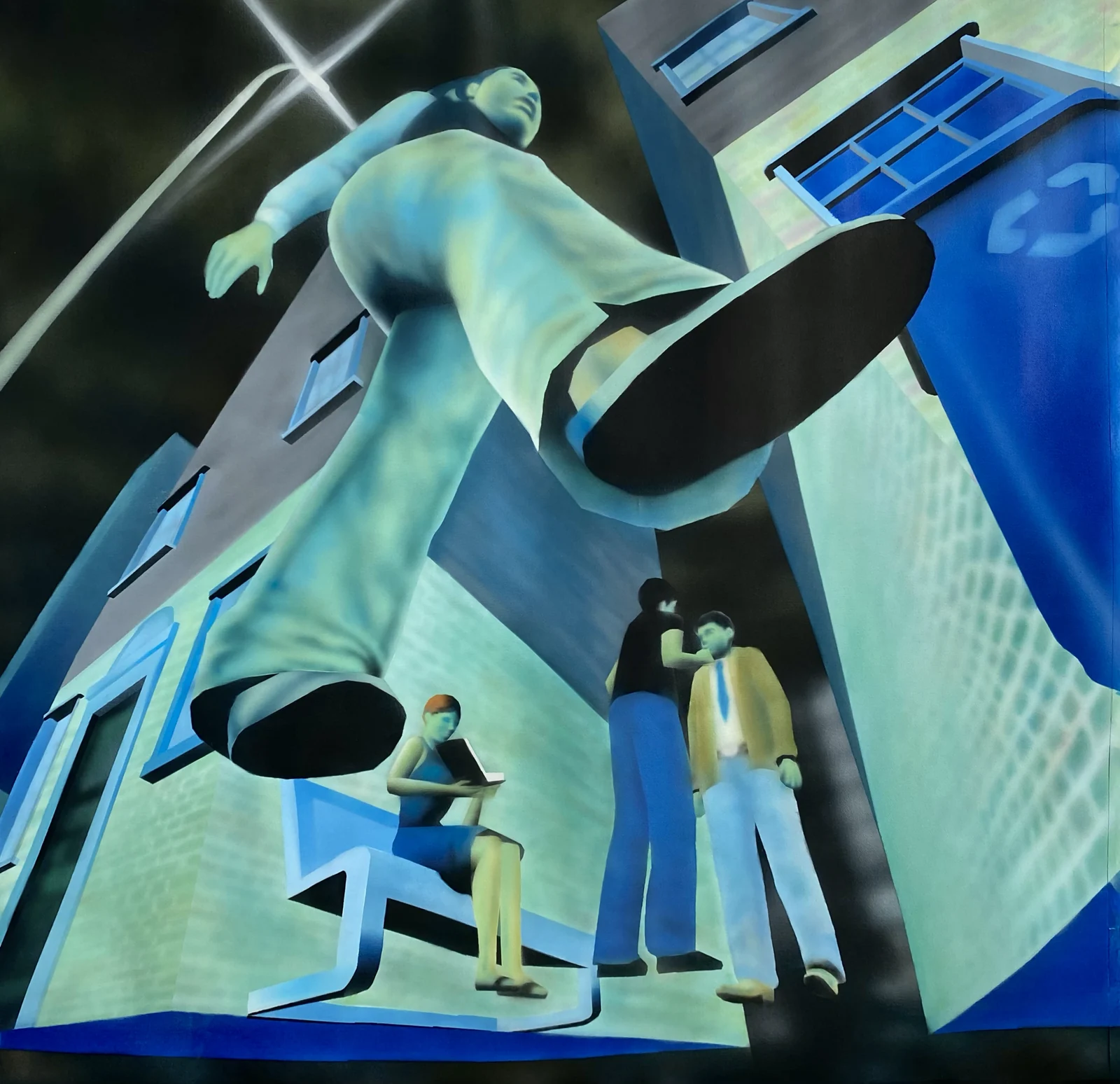
Those days it wasn’t only the temperature that was subject to rapid change, but the skies, whose blue, baffling in its entirety, gray would crawl over so immediately so as to act nearly devoid of any duration. One would blink to blue skies and open to a flat wall of gray, blink again and open to bare blue. The sky was too big. It wasn’t necessarily bigger than any of the places I’d lived before, but it was almost always entirely empty or entirely full, which gave it the feeling of being larger than it was, unpopulated and void. An estranged friend, Tom, a devoted Freudian psychoanalyst I saw three times a week during my graduate days, liked to say that how one felt about flying mirrored their sentiment toward death. It was something Tom’s analyst had told him when he was just a teenager, and it stuck with him. But it seemed more elemental. How one felt about the ground, the sky, seemed to me the litmus test of their tolerance for the reality of the void, the nothingness imbuing everything with meaning. And I remembered how Freud would faint every single time he tried to travel to Rome, that poor man. His unconscious made itself clear there. Los Angeles, with its blatant segregation and alienation, went to no pains to disguise death. Smog obscured buildings and hills and freeways most days, smothering everything in a vague and torrid brown. On better days, gray. The rich people kept to the rich people kept to the rich people, for whom the city could be lawless, a place of exciting and frenzied anarchy, while the police waged war on specific neighborhoods, mimicking the ever-present buzz of drone warfare as helicopters circled and circled chosen streets and intersections, letting only some know: I am always watching you. So it confined violence to only some bodies, while the spared rest said, “The weather! The sunshine!” It was a horrible city, those around me and I thought. Hell on earth. Lines of pigeons on telephone wires, squirrels trailing the same wires, box cars and bridges, the industry of Westward expansion rolling, rolling out on billboards and in squealing tires and in lips, and asses, and bleached hair, and the smog. The spectacle of death. A swarm of pigeons had launched into the air as I walked one morning, and the sound was that of an engine, a revving so incredible it only could have come from an animal not human. No one in the city read, we would complain. No one in the city read. It was because, we decided, people in other places still used culture, knowledge, as a means of capital. But LA ran on the image. The stereotypes were true: people in Los Angeles only used capital as capital, or, sometimes, image as capital. It was representative of our new era of the image, we would nod, pleased with ourselves. But even image as capital was on the way out. Each of us liked to speculate about what came next—youth as capital, eternity as capital, painlessness as capital—knowing none of us would likely be around to see it. We weren’t of the class that could afford a long life. It was an American problem, we Americans would scoff. We were all so righteous, in those days, because we thought, or hoped, it might save us. We were young, did I mention that? We were kids, really. And we were scared, because, like I said, Los Angeles went to no pains to disguise death. So we, rat-faced from behind our glasses, watched it every day. And we were scared.
The people I knew who did read were poor and mentally ill. Few of us escaped that category. Many friends at the time who’d been laid off at the university were making some money substitute teaching. It was the gig job for those with a college degree, a Germanist friend once powerful in the Comparative Literature department liked to say. A poet friend in the industry tried to explain to me how he explained to a student the process of multiplying a number by one, the fact that it remained the same. This a young girl could not understand. He had told her it was like looking in a mirror. I worried for the children’s education.
“That’s wrong,” I remember arguing. “Looking in a mirror is like multiplying by two or dividing by two, but absolutely not like multiplying by one.”
“It depends how you look at it,” my friend said.
Well, this was true of everything. The last argument I’d had with my girlfriend went more or less the same way. I’d gotten sober, then our relationship had gone. For a long time, drinking had been the glue holding us together, making us giddy enough to sleep, to fuck, to pass the evenings together without boredom or questioning or malaise rearing up. But then it got out of hand, both of our drinking, and we’d stay up later and later, drinking more and more. When I missed a week of teaching because I was home in bed every day, retching, I knew I would either lose my position at the university or lose drinking. But our relationship was inextricable from my drinking. It had nothing to do with her, really, I tried to tell her. We had been together nearly six years. She was wonderful in many ways—quick and beautiful, funny and kind. Yet I always knew she would not be the person I would love, in the end. I couldn’t talk to her, really. Still, it had nothing to do with her, I tried to tell her, I just had become someone else, someone I didn’t recognize. People were malleable, they were. But it depended on how one looked at it, she said. Well from where I’m standing, I’d told her, it had nothing to do with her. From where she was standing, it did. She thought I was in love with someone else, though I assured her I wasn’t. There was mostly only myself during that time, and I felt sick. I wasn’t well. I don’t know where she is now. She didn’t want to be in touch.
II
I’d started sleeping with a graduate student whose name I can’t repeat, but whom I’ve taken to calling Belle. Because I was a kid when I began graduate school, she was older than me. I’d gone straight from undergrad, to my PhD candidacy, to teaching. It wasn’t uncommon that my graduate students were either my equals or my seniors in age.
Belle kept her hair short and those in the department called her “the one with the eyes,” owing to the fact that she looked at people and things for too long, longer than was either necessary or acceptable, and that her eyes were disconcertingly large from an illness when she was a child. In someone more masculine, this characteristic would be disturbing if not threatening, but in Belle it only endeared others. She was beautiful in a way that could easily be missed. In a crowd, she would never stand out. But if you met her in a small group, or just her, it was the eyes. She saw. She really saw. This is how it felt. Not only that she saw what was inside you, but that she didn’t mind whatever it was she saw, that it was okay, whatever was inside, evil or grotesque or shameful or painful beyond words, it was okay. All the men of the department, it was obvious, all of us agreed privately and quietly on this.
Of course, it was all projection, none of us could know what she saw or what she thought, because she was often quiet and because we didn’t or couldn’t ask. Because Belle was quiet beyond what was necessary or acceptable, we could project whatever we needed into her eyes, and that’s who she was: someone to see us and forgive us. God, we were all terrified. Belle saw me, I thought. I thought she saw me without my needing to say anything. And it had been a very long time, since I was a child, maybe, that I’d felt that specific feeling I felt with Belle.
I first met her when she was a student in a graduate seminar I was teaching on the surrealist artist and writer Leonora Carrington. Why precisely the department’s cuts had led me to teaching this hyperspecialized course remains a mystery, but I was. Carrington’s art I adored, but her writing—save for the memoir/novel Down Below, the book that tracks Carrington’s psychotic episode after Max Ernst was detained in a camp—it did not speak to me. Her biography was, of course, formidable. Still, on the whole, I didn’t care for the surrealists. Their relationship to the women of their movement was troubling, Bellmer and Breton and Ernst, no, they scared me. The automatic drawings, the rayographs, these were different in that the process shifted or obscured the work. The writing, Breton in particular, no, I couldn’t stand it. Carrington’s fiction was no different, but there was something in Down Below that struck me as significant, particularly if examined through a Lacanian lens. This was the primary work of the seminar, which met in a fifth-floor room that possessed no windows. A large oak table sat in the center of the room, eight chairs surrounding it, and some chairs that couldn’t fit positioned in a ring surrounding those framing the table. How the university had passed a building plan that allowed for an entire building to possess not a single window eludes me, but it did. The building was all wall, continuous and unbreaking. No sunlight ever crossed the boundary to touch the inside.
Belle first came to my office hours because she wanted to discuss the desire for wholeness in Down Below. I remember she had written out notes on a legal pad that she kept loose in her leather shoulder bag, with little stars scribbled next to certain quotations, other words entirely capitalized. I hadn’t noticed her before, really, though I’d heard the other men in the department speak about her here and there. She didn’t speak in my class, frequently sat in the ring of chairs outside the immediate circle, came on time, and left promptly. Besides, I made it a habit of not looking too long at certain students, particularly those the other men mentioned. I didn’t want to come across a certain way to the women in my class, nor even the handsome men. So she hadn’t registered to me until that day.
I remember, still, some of the quotes she’d brought in on her little yellow legal pad. “Seeking through gentleness an understanding between the mountain, my body, and my mind,” was one. I remember it because she told me that day that she was from a rural village in the Dolomites, and it was clear to me then that what she found interesting in the text was not merely theoretical, but, of course, personal. She was particularly interested in a moment that came near the end of the text, when Carrington has nearly finished describing her time in a psychiatric ward. “I would say,” Belle quoted, “‘Who am I?’ while thinking: Who am I to you?” She was interested in this, the I and the Other and wholeness. And so we talked. I mentioned, if I remember correctly, Lacan and Levinas, Martin Buber, maybe. Oh, there was another quote, I remember. “It seemed impossible to communicate with the outside world.” She wanted to talk about this. And: “I did not want to make use of violence against a woman for the sake of saving myself.” Belle thought this was unusual, particularly in the canon of schizophrenic texts that often viewed the other as purely persecutorial.
I was only seven months sober, newly obsessed with the fact that one letter separated fatal from fetal. I had no idea who I was to be giving advice, scholarly or otherwise, to anyone. It felt as though I was an empty vessel within an empty vessel surrounded by empty vessels, the whole world empty, like a Russian nesting doll, each containing emptiness, and emptiness, and emptiness. This is what I was thinking the first time Belle came to my office, that the world was nothing but emptiness and I had no right to advise anyone. Still, I listened the best I could. She was beautiful, like I said. She had a habit of turning her face up toward the ceiling when she spoke and raising the inner lines of her eyebrows, and I remember thinking the way she raised her eyes upward seemed as though divine providence were taking place right there and then, God delivering to her each of her words. She wore a wedding band, but did not speak of any husband, only a son who lived with her in the small university apartment she kept not far from campus. When I asked how old her son was, after a long pause she answered that he was seven. She didn’t want to tell me more, I thought, but then she went on. His age, she continued, eyebrows pinched, meant that her life had not been hers for seven years. Seven years she had spent living her life as if split, her being split between herself and the boy.
“It’s why I don’t want children,” I said.
“That’s not what I mean,” she corrected. “He has been the greatest gift of my life.”
“Besides,” she continued, “you’re young. There’s still time to change your mind.”
It was dark by the time Belle and I finished talking, at which point I offered to walk her to her car. A series of petty crimes had been taking place on the campus, and I worried. That was it. We parted without touching. I drove home through the clogged freeways back to Los Angeles. Because the air conditioning in my car was broken, I drove with the windows down, the wind loud as a motor through the gaping holes. I changed into the elastic shorts and shirt I kept beneath my bed. I ran through the voided streets, the orbed streetlights becoming Belle’s eyes in the dark. Son and sun, I thought. Son and sun.
She came back each week after that. When exactly we started sleeping together, I don’t know really. It happened with the speed of inevitability. In class, she continued not to speak, sitting in the outer circle, scrawling notes quietly on her yellow legal pad. She came and left promptly. No one would have ever guessed we had a relationship of any kind.
Only after several months of seeing one another did I finally get the nerve to ask about the wedding band. Belle told me without any sentimentality that her husband had died when their son was four. They were living near his parents in the town in Italy from which both came. He had grown up climbing and skiing the mountains summer and winter, she said, and often left early in the morning to hike or ski beyond their house, returning before the sun and boy were up. He was a musician, too, and would bring a small machine to capture the sounds of the world opening. River water echoing beneath frozen ice. The breaking of snow from branch. Wind pushing croaks from trees. They looked alike, she said, her husband and the boy. It was in the eyes, and the way they walked, and the way their cheeks and neck turned pink in the cold. Then, one day in March, he didn’t come back from a morning gone skiing. He hadn’t left a note, nor told her where he was going, only an empty mug on the counter, the bottom stained with coffee. They found his body beneath a cliff only months later when the snow had melted, and the ground was soft, new plants pushing through soil. They never found his recording machine.
“Some people,” I remember her saying, “some people are not really suited for this world.” She said it without any affect. “It’s not so bearable for them.” We were lying together in her bed as she spoke, her eyes boring into the ceiling. It was the afternoon, her son at the university’s elementary school. Clouds obscured the sun that day, and condensation had piled on the window above the bed. Simone de Beauvoir had written something somewhere about the adventurer—the escapism of that life, though I didn’t say this, didn’t comment on the death of her husband. What was there to say? Then I remember she closed her eyes. “I wake up most days alone,” she said, “but not lonely. I don’t mind all the space around me. I get my son to school.”
Her eyes remained closed as she continued. “Then as the days go on, I begin to acquire loneliness, even with people and books and classes and my son, the loneliness seems to build and build, so that, by the end of the day, even if I am with people or my child or the sun is burning the sky miraculously, it is like I cannot see it or feel it through the film of the loneliness. So even when I see people, see you, for instance, it is only in an attempt to stave off the loneliness, to put it away for some time.” I watched a bead of dew crack down the window. “And still,” she finished, “I find there is nowhere for the loneliness to go. So I go to sleep, and wake up okay the next day, until the loneliness again begins to build.” Because she hadn’t grown up speaking English, she spoke in a high register, formal and ornate. She was quiet for a moment. “I knew great love once, with my husband, and it was the only time that emptiness went away. It can’t happen like that so often. It’s rare, to find something like that in another person. I don’t think it will come again for me.” I remember lying still for a moment, then standing up and walking out. There was nothing to say. I’m of the opinion that one should not say anything when they find themselves without anything to say. She understood this, I know. That was the point she was trying to make. She was giving me permission to go.
Belle never asked to be together, never alluded to wanting that. If anything, I would have liked it more than I think she would have. But it wasn’t a possibility, this we both knew. After that day, she didn’t mention her life before graduate school again. It was not something we spoke about. One afternoon, though, I got some inkling she wanted me to stay longer after we’d finished. I’d never met her son, didn’t want to. I hadn’t thought she wanted me to, either. If people knew we were having a relationship of any kind, it would have threatened my position at the university, and it would have undermined her research and standing. We both knew this, so it wasn’t something we discussed. For her sake, I believe, more than mine. She was a young woman, smart in her own right. She didn’t want to be seen with me. Still there was the one afternoon it seemed, only briefly, that she wanted me to stay a bit later, until her son was out of school. “One can’t pour from an empty cup,” I had told her, as some kind of apology.
“You’re too smart to say that,” she said. “It sounds like something on a tea bag.” Then we’d laughed a bit, and I’d left.
The last time we slept together, it must have been the wintertime. It was early afternoon, and already dark.
I didn’t hear her.
I didn’t hear.
We were lying together, same as always, and I didn’t hear her when she said no. I don’t think she repeated it, no, she couldn’t have, I would have heard her. I would have heard her, I know it. She was already naked, she must have been. And me, too. And then when I finished, I remember only her asking me to leave, telling me I had to go. That she needed to go fetch her son.
She said there was blood on the mattress after, when I wrote to her and asked why she had stopped speaking to me, but I never saw the blood. It was already dark in the early afternoon. I would have heard her.
I didn’t hear.
She continued coming to class, arriving promptly and leaving promptly, but we didn’t see each other outside the seminar again after that afternoon in the winter. She would not meet my eyes when I looked at her. How could I have missed it? I wasn’t well. How could I not have heard her? How? She had been quieter than normal that dark afternoon, I know, and her eyes had been closed, I remember, but wouldn’t I have heard her? How didn’t I hear?
I gave her an A on her final paper without reading it. I don’t believe I had any right to read it. I remember she’d used an epigraph of the same quote she’d first brought to my office: “Seeking through gentleness an understanding between the mountain, my body, and my mind.” The course ended, and I didn’t see her again for a while.
The next year, I saw her only once. I’d had to go to campus for an end-of-the-year faculty meeting. She was walking with her son. It was warm and bright, summertime, and they went slowly across campus both in sandals. He was wearing a light blue shirt, the same color as the sky, and had long curly hair that fell out onto his shirt collar in ringlets, bouncing a bit. He was tall for his age and thin, his shoulder bones visible through the sky of his shirt. He clutched Belle’s arm, and she held onto him tightly. While at first it seemed to me that they were walking quickly together, as if someone were chasing them, I realized as they came closer that Belle was smiling. I remembered something she had written on her legal pad, “I did not want to make use of violence against a woman for the sake of saving myself.” Her son said something, then, and she began quietly to laugh. I remembered her telling me that he walked in the same way as had her husband. For some reason I wondered, then, where her husband’s recording machine had gone, if it were buried in the mountain’s soil, or torn against rock at the bottom of a creek, or found by someone else, who puzzled over the Earth’s sounds captured and played through the cogs and speakers.
Soon after I saw her, I found a note in my department mailbox. “Your guilt has no direction toward me, no direction outward, it has only entirely to do with you. Though you might either think this is the worst thing you have done, or you might think it was entirely a misunderstanding, it is not the worst thing that has happened to me, nor does it begin to touch upon the worst things that have happened to me. You cannot harm me. And I do not and will not think about you. I’m no happier and no sadder than I was before you.”
I gave up my position at the university. Soon the homonyms stopped bothering me. I often find myself thinking about Belle, but only two words plague me in the years since that winter. I’d fallen so deeply inside myself that I couldn’t hear the outside world. I didn’t hear her. How didn’t I hear? No.
I don’t know.